27,303 timed APTs labeled on CLEVRER and Physion++ videos.
Paper under review • Physical video understanding
Physics unfolds
one transition
at a time.
Atomic Physical Transitions turn a video event into an ordered chain of what changed, why it changed, and when.
FIG. 01From a clip label to a transition chain
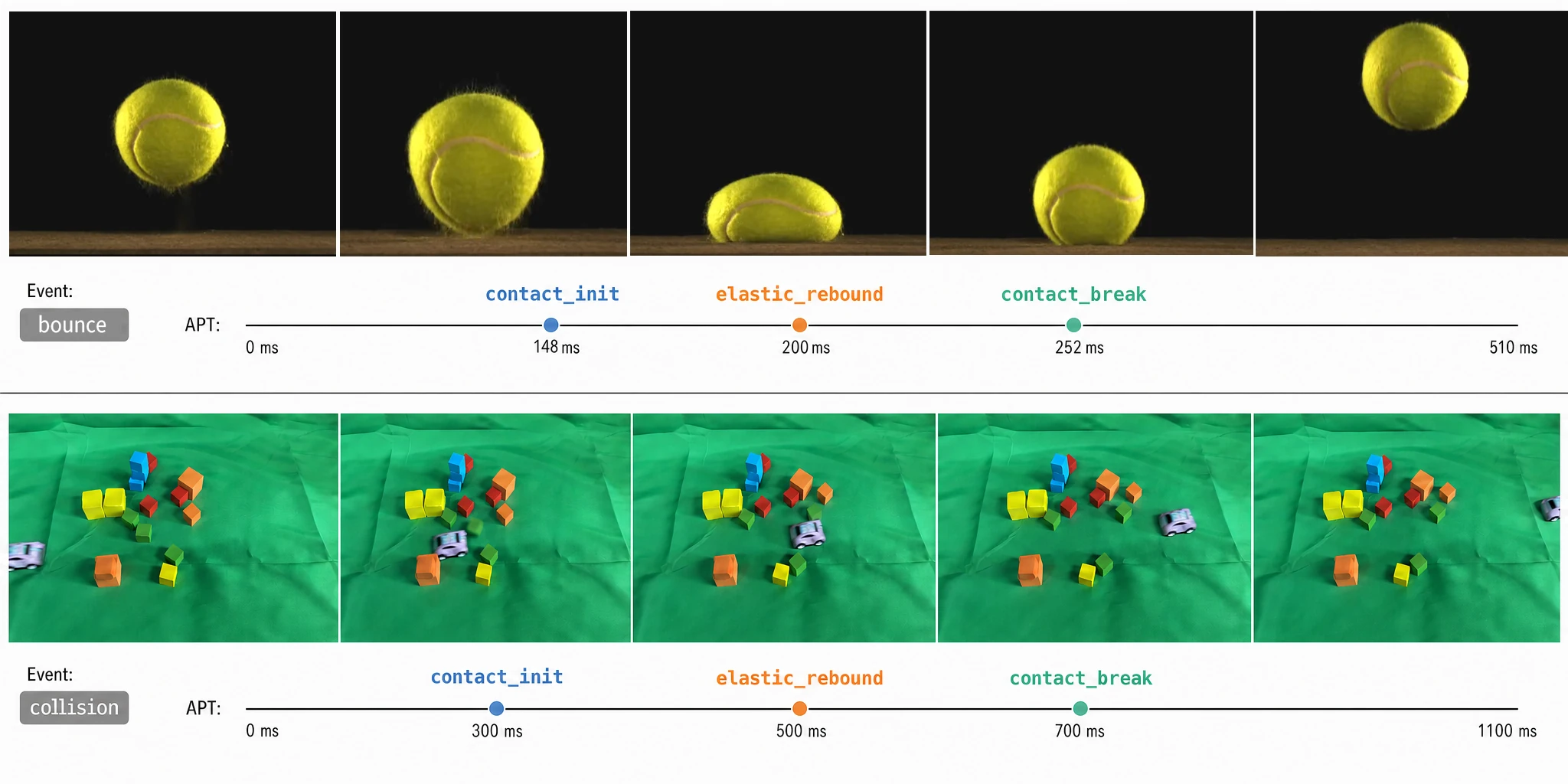
The same physical transition can appear in very different scenes.
14transition types
2,500video trials
~55Ktimed APTs
500test trials
01 / THE IDEA
An event label tells the ending. APTs show the process.
A “bounce” can contain contact, rebound, separation, and settling. APTs locate these mechanism-typed state changes in time, between clip-level labels and full physical-state simulation.
Eventbounce
- 148 ms
contact_inittwo surfaces begin to touch - 200 ms
elastic_reboundmotion reverses after impact - 252 ms
contact_breakthe touching surfaces separate
A compact, ordered account of the visible dynamics.
02 / DATAHuman anchored.
Human anchored.
Simulator scaled.
Human annotation defines visually recognizable transition boundaries. Rule-guided simulation adds diverse scenes and labels from realized contact, motion, and support changes.
Approximately 27,700 APTs derived from simulated state traces and visual checks.
Evaluation split500 test trials · 10,200 ground-truth APTs · 20.4 APTs per clip
FIG. 02Rule-guided construction and scene generation
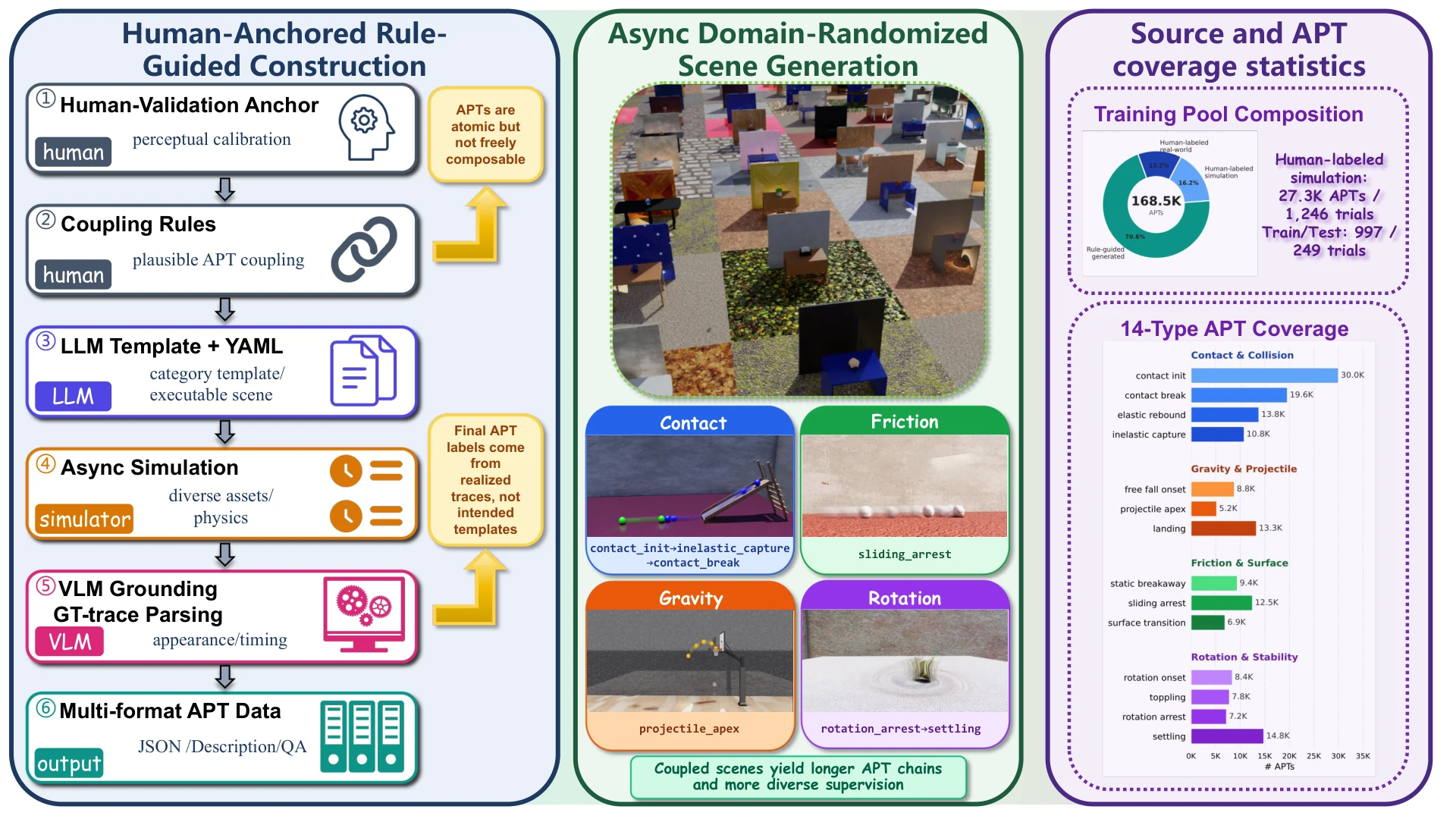
The construction workflow, from rules to grounded transitions.
03 / EXAMPLESA shared vocabulary
A shared vocabulary
across different scenes.
The taxonomy covers contact and collision, gravity, friction and surface dynamics, and rotation and stability. Labels name local state changes, not object categories.
FIG. 03Simulator-derived APT examples
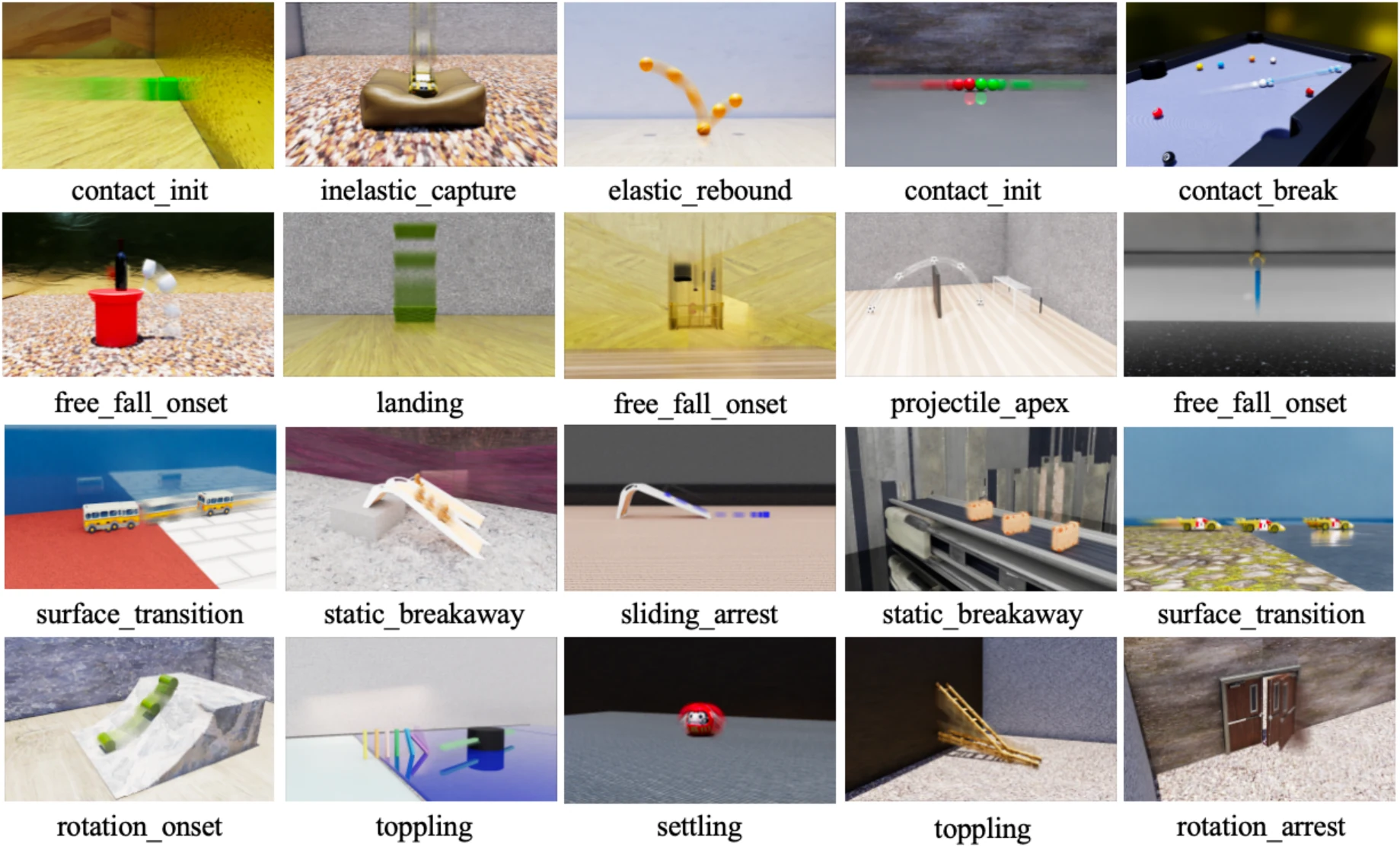
The same transition types appear across varied objects, materials, and settings.
04 / LEARNINGFrom APT chains
From APT chains
to better video models.
APT-Tune combines structured transition supervision with ordinary video answer formats. The reported mix has 1,000 APT video trials, 1,000 SSv2 multiple-choice examples, and 1,000 descriptions.
FIG. 04APT-Tune training recipe
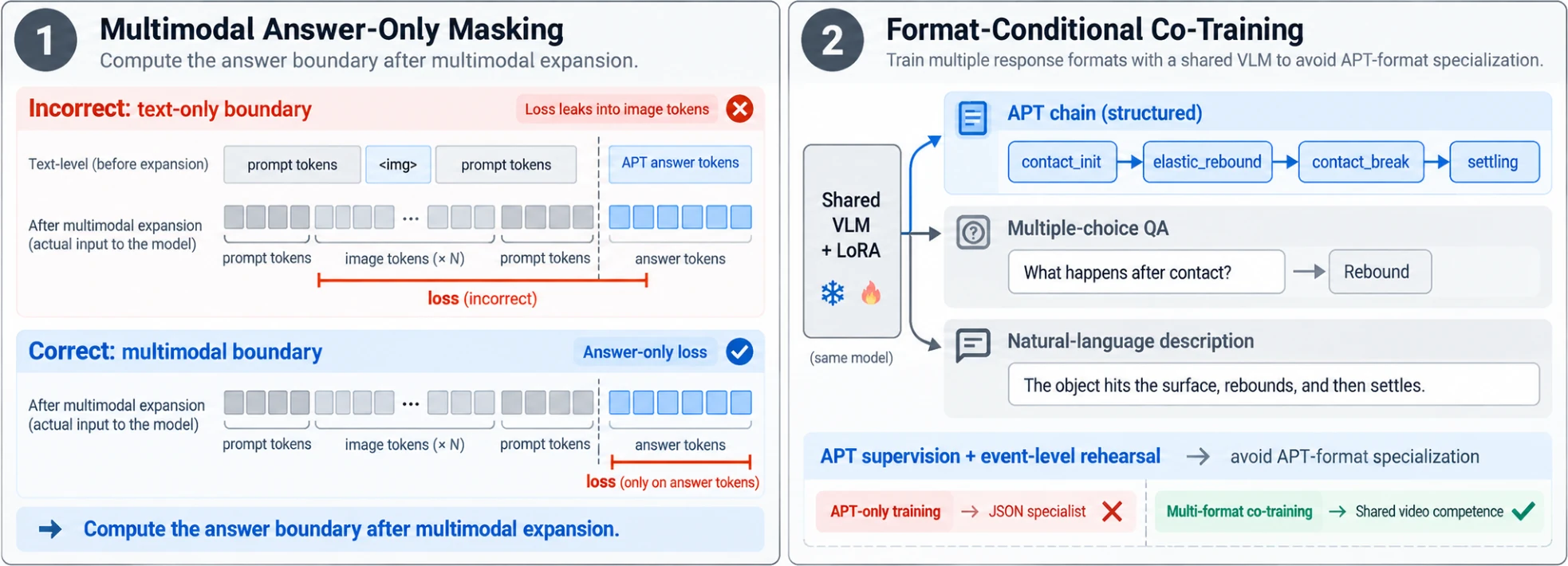
One backbone learns from APT chains while retaining ordinary question-answer formats.
05 / RESULTSTransition recovery
Transition recovery
improves across backbones.
Under the shared 32-frame protocol, twelve zero-shot systems recover only 10.0–15.2% of test transitions. APT-Tune improves recall for all six trained open-source backbones.
APT-Bench recall
500 test trials · 10,200 APTs · higher is better
Zero-shot+ APT-Tune
Qwen3-VL 2B10.0 → 38.1%
Qwen3-VL 4B11.0 → 42.5%
Qwen3-VL 8B12.0 → 48.6%
InternVL3.5 2B14.0 → 46.8%
InternVL3.5 4B13.0 → 48.0%
InternVL3.5 8B13.0 → 53.4%
Recall gain: +28.1 to +40.4 percentage points across six backbones. Matched-event timing error also falls after tuning.
28.2%
Recall remains after capping APT-Tune to each clip’s zero-shot prediction count on Qwen3-VL-2B, versus 10.0% zero-shot recall.
+18.4 pp
Mean gain on five selected PhysBench motion and spatial subtypes for Qwen3-VL-8B. This diagnostic covers one backbone.
MANUSCRIPT STATUS
Paper under review.
The manuscript is not publicly available during anonymous review.